AI Assistant — Concept Note Evaluator

Know what a reviewer will flag — before you submit.

The Concept Note Evaluator evaluates your draft Concept Note against the same evidentiary and investment-criteria standards applied to real, approved concept notes — and gives you structured, actionable feedback so you know exactly what to strengthen before formal submission.
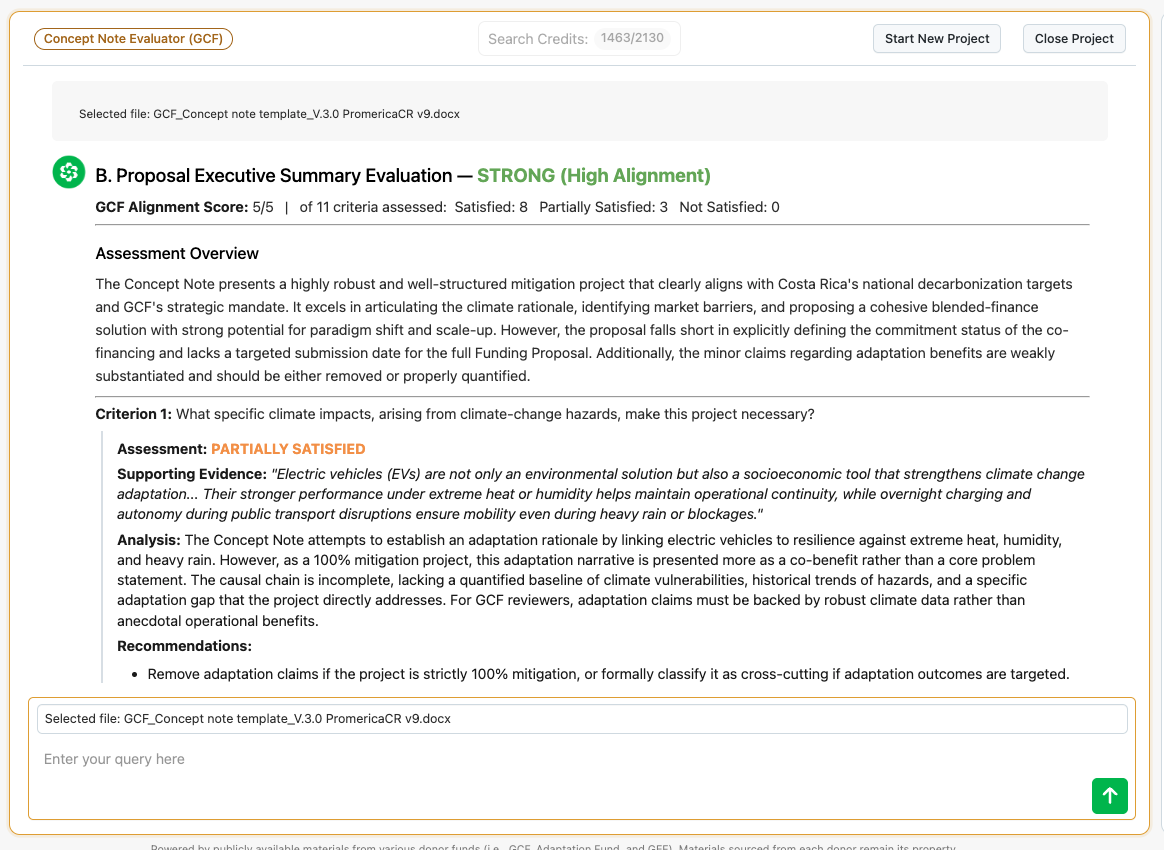
Concept Note Evaluator interface

What They're Saying

"This is a fantastic tool for building confidence in our submissions. It not only validates the relevant information we've already included but also provides a clear roadmap of areas needing more attention."
Caribbean Accredited Entity
"The detailed evaluation of the Theory of Change was particularly informative and helped us significantly improve our proposal's core logic."
Southern Africa Accredited Entity
"What sets this software apart is its deep qualitative feedback. It goes far beyond a simple checklist, providing a specific assessment with concrete recommendations for improvement."
Pacific Accredited Entity
"Many DAEs have a very strong technical and structuring background — but writing in a way that convinces the Donor in English is a real challenge. The linguistic opportunity here is significant, and this tool could address that."
Multilateral Donor Reviewer
"My first impression is that it's really spot on. I compared its analysis against my own review of the concept note from over a year ago and they were quite aligned. That level of consistency with expert judgment is what sets it apart."
Multilateral Donor Reviewer
"There is clearly real potential here. We're trying to improve both efficiency and access — and those are almost two separate directions. There are DAEs that need considerable handholding, and if something can help them translate ideas into English, and into Donor language and finance logic, those different layers of translation are truly useful."
Multilateral Donor Reviewer
How It Works

From draft upload to submission-ready concept note.

A fast, consistent first-pass check — before your concept note reaches a Donor's desk.

1
Upload Your Concept Note
  • Submit your draft as a direct document upload
  • No manual reformatting or data entry required
  • The evaluator works with your document as-is
2
Evidence-Based Evaluation
  • Checks for internal consistency and completeness
  • Evaluated against investment criteria from donors' scoring rubrics.
3
Structured, Actionable Feedback
  • Specific weaknesses flagged section by section — not a pass/fail score
  • Tells you exactly what to strengthen before formal submission
  • Covers missing data, unsupported claims, climate rationale gaps, and Donor alignment
The Standard

Not a generic AI critique. Real evaluation standards.

Benchmarked accuracy
Assessments validated against actual approved concept notes — not a theoretical rubric.
Benchmarked accuracy
Assessments validated against actual approved concept notes — not a theoretical rubric.
Section-by-section output
Structured feedback tells you exactly where the concept note falls short and what to fix — not a single score.
Investment-criteria aligned
Evaluated against the same criteria applied by Donors to real submissions — not generic best practice.
What It Evaluates

Six dimensions. Section by section.

Rather than a generic AI critique, the Concept Note Evaluator flags specific weaknesses at the level a Donor reviewer would look for.

Internal Consistency
Whether the sections of the concept note actually align with each other — activities, outcomes, budget, and evidence telling a coherent story.
Completeness
Whether required elements are present and developed to the level a reviewer expects before a submission is advanced.
Evidence-Supported Claims
Whether the claims made in the document are actually supported by the evidence cited — not asserted without basis.
Climate Rationale Gaps
Specific gaps in the climate rationale — missing data points, unsupported hazard claims, or evidence that doesn't meet the evidentiary standard for the geography and sector.
Alignment with Donor Investment Criteria
Whether the concept note addresses the core investment criteria a Donor applies — not a generic checklist, but the standards from real approved submissions.
Missing Data Points
Named gaps at the level a reviewer would flag — and where those gaps are closable from existing sources versus requiring new data collection.
FAQ

Common questions about the Concept Note Evaluator.

It reviews a draft Concept Note before it reaches a Donor and produces structured, actionable feedback on what needs to be strengthened before formal submission. It checks for internal consistency, completeness, and whether the claims made in the document are actually supported by the evidence cited — flagging specific weaknesses section by section. The output tells a project developer not just that something is weak, but where it is weak and why, so revision is targeted rather than speculative.

A general AI tool will apply generic writing and logic criteria, not the specific evidentiary and investment standards that Donors actually use to assess concept notes. An internal reviewer brings expertise but is time-constrained, subject to familiarity bias, and unavailable at scale when you're managing multiple applications. The Concept Note Evaluator applies evaluation criteria grounded in real, approved concept notes — not a generic rubric — and does so consistently, on demand, at the start of the review cycle rather than at the end when it's most costly to revise.

The tool accepts a Concept Note as a document upload — no manual reformatting or data re-entry is required. You upload the document as-is, and the system processes it directly. This is deliberate: requiring manual transcription or structured data entry before you can get an assessment would defeat the purpose of a fast first-pass tool.

The output is structured, section-by-section feedback rather than a single pass/fail score or a general narrative critique. For each section, the evaluator surfaces specific issues: missing data points, unsupported claims, gaps in climate rationale, or misalignment with Donor investment criteria. This makes the output immediately actionable — a project developer or reviewer knows exactly which sections to prioritize and what specifically needs to be addressed.

The evaluator has been benchmarked against actual approved concept notes to validate that its assessments align with the evidentiary and quality standards applied in real Donor review processes. This grounding in real precedent — not a constructed rubric — is what distinguishes it from a generic AI critique. We can share more detail on the validation methodology with institutional clients during due diligence.

The tool's evaluation framework is grounded in the standards and patterns common across major climate finance programs. It does not require a Donor-specific configuration for each submission, though the depth of its benchmarking reflects the programs most represented in the underlying corpus. If your portfolio includes submissions to programs with very distinct requirements, your account team can discuss whether specific calibration is warranted.

Significantly faster than a manual review cycle — assessments are generated in minutes rather than days. The value for institutional users managing multiple applications simultaneously is that the turnaround doesn't create a queue: you can run an assessment as soon as a draft reaches a reviewable state, rather than waiting for reviewer availability.

That's the primary institutional use case. Rather than routing every draft through a small pool of senior technical reviewers, teams can use the Concept Note Evaluator as a consistent first-pass filter — advancing the documents that are genuinely ready for expert attention and returning the weaker ones with specific revision guidance before they consume reviewer time. The result is fewer weak submissions reaching formal review and a higher-quality portfolio entering the Donor pipeline.

Usage is token-based, tracking the length of the document processed and the evaluation output generated. Token consumption per evaluation is predictable and scales with document length. Administrators can track and manage usage across their team through the Master Administration Panel. Specific pricing is available from your account team.

The evaluator is a first-pass quality check, not a guarantee of approval. Concept notes that pass the evaluator's assessment may still face questions in formal Donor review — particularly around project-specific local context, stakeholder relationships, or political considerations that don't appear in the document itself. Equally, the tool flags structural and evidentiary weaknesses; it doesn't replace the judgment of a climate finance professional on strategic positioning. Think of it as raising the floor of submission quality, not capping the ceiling of what expert review adds.

Raise the bar before a Donor
sees your concept note.

Structured, actionable feedback — grounded in real evaluation standards.

Request Access Talk to us