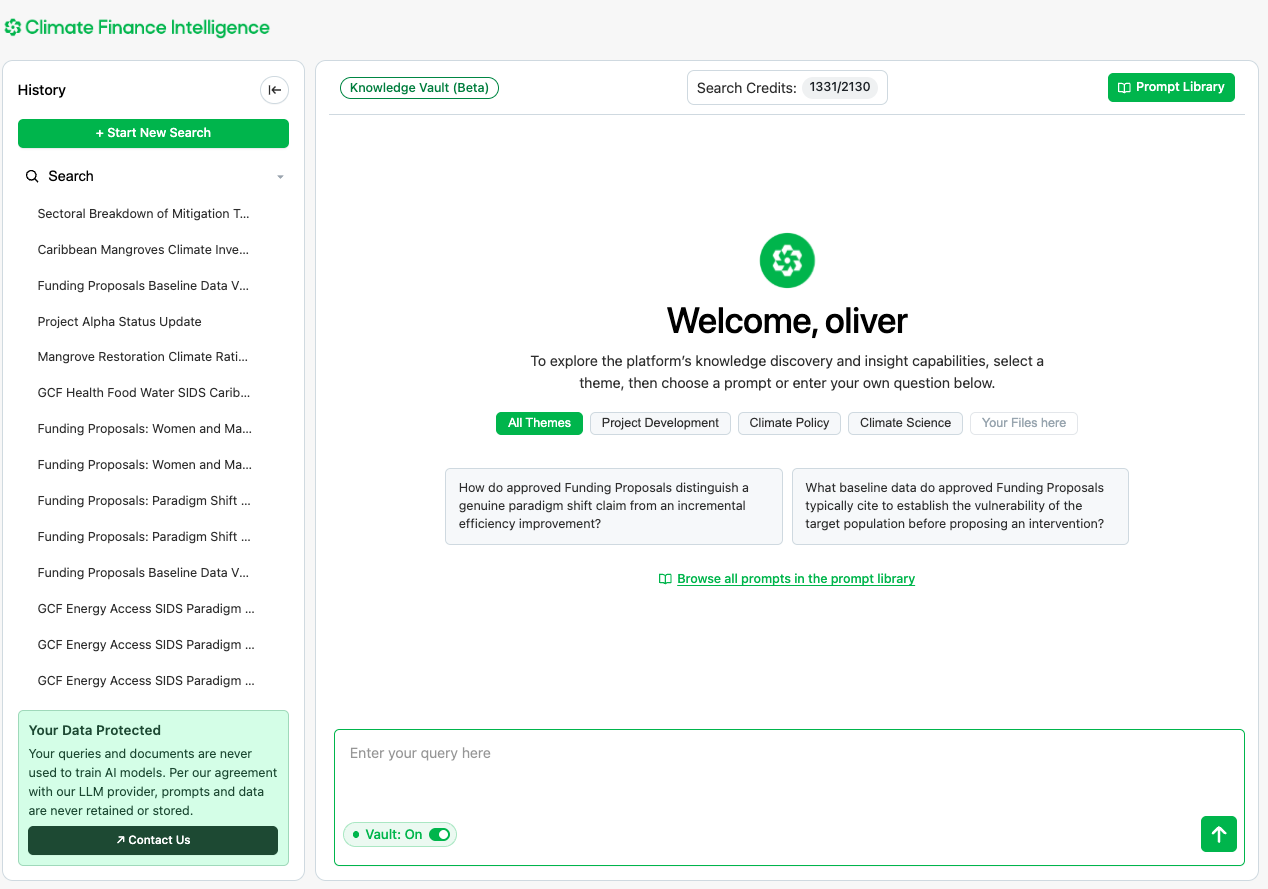
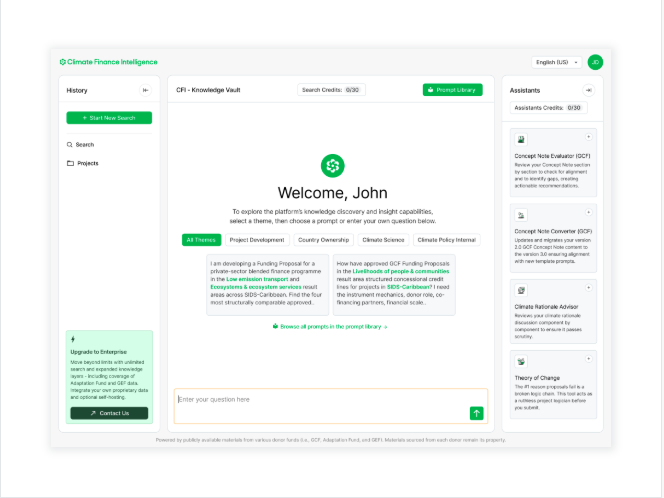
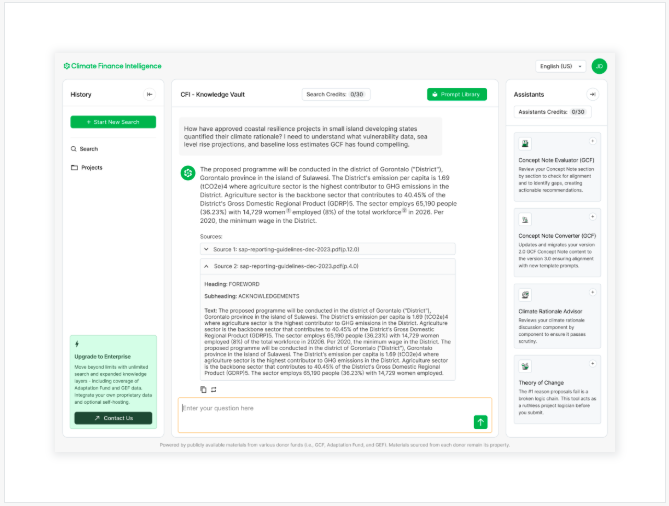
The Knowledge Vault is a curated climate finance corpus, not a general-purpose AI trained on the open web. Every response is grounded in source documents, to include your own institutional files and every claim linked back to a specific source and page. This approach ensures no hallucinated responses.
Don't just guess — build. Instantly access proven models, logic and arguments from thousands of approved project files to strengthen and align your submissions.


CFI (Climate Finance Intelligence) is a comprehensive knowledge management platform that centralizes all the resources and files required to develop project ideas and rigorously stress-test drafts prior to submission.
Work that would otherwise require days of manual document review compresses to minutes — with full source attribution intact.
Outputs are structured to fit the task — not just a paragraph of text.
It gives your team a research interface grounded in a curated climate finance corpus — not a general-purpose AI trained on the open web. When you ask a question, the system retrieves the most relevant source documents from its underlying knowledge base and uses them to generate a response, with every factual claim linked back to a specific source and page. The practical result is that work that would otherwise require days of manual document review — finding comparable funded projects, verifying climate rationale evidence, checking policy alignment — compresses to minutes, with full source attribution intact.
General AI chatbots draw on their training data, which is broad but unverifiable, undated, and not traceable. They can't tell you which document a claim comes from, they may confuse projects from different geographies or vintages, and they have no mechanism for knowing when their training data doesn't cover a specific country or topic. The Knowledge Vault is the opposite: every response is grounded in a curated, maintained corpus of approved funding proposals, peer-reviewed climate science, and national policy documents. If the corpus doesn't have sufficient coverage for a given geography or question, the system tells you that explicitly rather than generating a plausible-sounding but unverifiable answer.
The corpus spans three main categories: (1) approved funding proposals and comparable project records from Donor programs; (2) climate science literature — including IPCC assessment reports, regional climate risk profiles, and national meteorological data; and (3) national policy documents such as Nationally Determined Contributions, National Adaptation Plans, and National Communications. Each category is maintained separately so the system can route your query to the right underlying source, distinguishing a request for comparable projects from a request for climate science evidence or national policy context.
Geographic specificity is a core design requirement, not an afterthought. Each region's science and policy corpora are maintained separately, and the system routes queries accordingly. A query about climate risk in a specific Small Island Developing State will draw on that state's own climate profiles and national documentation — not pooled regional averages that could misrepresent local conditions. Current coverage spans multiple SIDS and LDC regions, and the corpus is continuously expanding.
Yes — and this is one of its most important properties for institutional use. When the underlying corpus lacks sufficient documentation for a given geography or topic, the system surfaces an explicit coverage-gap disclosure alongside its response rather than attempting to fill the gap with inference. For a sector where an unsupported claim in a submission can cost months of back-and-forth with a Donor, knowing the limits of available evidence is as valuable as having the evidence itself.
Two design choices work together. First, retrieval-augmented generation means the model isn't generating from memory — it's responding based on documents it has just retrieved, and every claim is tied to a specific source and page. Second, the corpus itself is curated and maintained, not a general web crawl, which means the underlying material is high-quality and Donor-relevant. That combination doesn't eliminate the possibility of error, but it means errors are detectable: you can check the cited source directly.
Outputs are structured to fit the task. Depending on what you're working on, the system can produce side-by-side comparable-project rankings assessed against your own criteria, structured field extractions from funding proposals, or narrative synthesis across multiple sources. Multi-turn conversation is supported, so you can ask follow-up questions, narrow scope, or request a different format without starting over — the system carries context forward correctly across turns.
No document upload is required to access the shared corpus — it's available immediately. If your institution wants its own proprietary documents (internal templates, project-specific reference material, in-house research) included in your team's knowledge base, those can be uploaded through the Master Administration Panel, which extends the platform with your own content. For the shared corpus, there is no setup step.
Three worth flagging. First, corpus coverage: the knowledge base is strong for the regions and Donor programs it covers, but if your work is concentrated in a geography or sector with thin representation in the corpus, the system will tell you — but that coverage gap is real. Second, document quality: the system performs best when the source documents it retrieves are themselves well-structured; very poorly formatted or scanned legacy documents may index with reduced fidelity. Third, it's a research and drafting accelerant, not a substitute for expert judgment — a climate finance professional reviewing AI-generated synthesis still adds value that automation cannot replace.
Access comparable projects, climate evidence, and policy alignment — in minutes, fully cited.