AI Assistant — Climate Rationale Builder

Build a defensible climate rationale in minutes, not weeks.

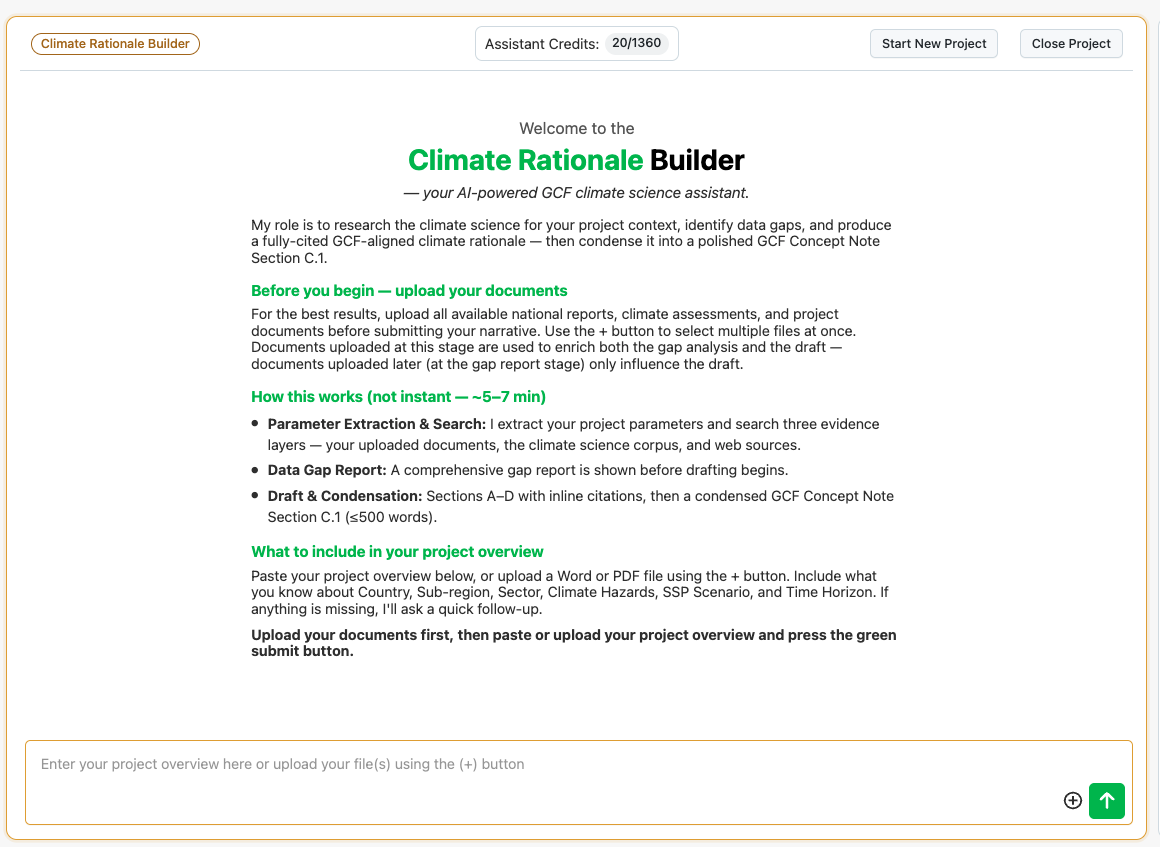
CRB researches the climate science for your project context, identifies evidence gaps, and produces a fully cited, GCF-aligned climate rationale — condensed to a polished Concept Note Section C.1.

Climate Rationale Builder interface

What They're Saying

"Integrating this software into our workflow means we can deliver superior quality proposals faster. This isn't about replacing expertise — it's about amplifying it."
Qavah Earth · Cape Town
"The ability to rapidly evaluate a concept note against Donor criteria is a game-changer. It saved us days of work and allowed us to deliver a superior product at a fraction of the traditional cost."
Project Developer · South Africa
"It would be wise to have the Concept Note Evaluator in the initial assessment and in the final stage as well. Useful for project developers, private players, and Donor applicants with limited experience."
Development Bank · Southern Africa
"The Converter tool was a lifesaver, migrating our Concept Note to the new Donor format in under two hours. The summary of changes would have taken us days of research."
Project Proponent · Africa
"I found your AI assistants very helpful in organizing ideas and aligning them with Donor criteria. Most importantly, it saved loads of time."
International Delivery Partner · Africa
"The Concept Note Converter has been an invaluable resource that bridges this gap, ensuring our CNs were aligned with the latest Donor standards."
Project Proponent · Zimbabwe
How It Works

Three steps from project concept to submission-ready rationale.

In minutes, establish whether the evidence for a project exists, where the gaps are, and what would close them. Do this before months of preparation effort are spent.

Try the Live Demo

No account required

1
Parameter Extraction
CRB extracts your project's geography, sector, and climate hazard. It then searches the climate science corpus, the country's national climate plans, and the web where the country-level corpus is thin.
2
Data Gap Report
Before drafting begins, CRB shows you where the evidence is strong and where it isn't — with specific gaps named at the level a reviewer would look for, and whether each gap is closable from public sources.
3
Draft & Condensation
A sectioned draft with inline citations, then condensed into a polished GCF Concept Note Section C.1 (≤500 words). Every claim is traceable to its source document and page.
Built-in Safeguards
Evidence-grounded outputs
Data gaps explicitly flagged
Full source transparency
Unsupported claims removed
Every figure cited to source
No hallucinations
FAQ

Common questions about the Climate Rationale Builder.

It takes a project concept and answers three questions: what climate evidence exists for this geography, sector, and hazard; whether that evidence meets the evidentiary standard the GCF has applied in proposals it has already approved; and where the evidence falls short, what specifically would be needed to close the gap.

It then produces a fully cited climate rationale narrative drawn from that evidence, with every claim traceable to its source document and passage.

Because the most expensive mistake in project preparation is committing months of technical and staff resources to a concept whose evidentiary foundation was never there. CRB surfaces that in minutes rather than after the first review.

For a team deciding where to direct limited preparation capacity, knowing which of three candidate concepts has a defensible evidence base — and which would require new data collection — is a resource allocation decision, not a drafting task.

A general model will find the science — any capable model with web access returns national communications, IPCC chapters, and regional assessments. What it cannot tell you is whether that evidence has ever satisfied a GCF reviewer.

The CRB is grounded in the indexed corpus of approved GCF proposals and the climate science sources cited within them. It answers a different question: not "does evidence exist" but "does this evidence resemble what has actually survived review?"

The principles the Board adopted in Decision B.33/12 (August 2022), set out in Annex VI. For adaptation these are Identification, Response, Alignment, and Monitoring and Evaluation.

For mitigation they cover NDC alignment, methodology selection, project boundaries, baseline and additionality, consistency with national GHG reporting, and MRV design. Outputs are structured against those principles rather than against a generic notion of what a good rationale looks like.

Less than most teams assume. The Board addressed this directly in Decision B.33/12:

"Decides that the use of best available information and data, including from the Intergovernmental Panel on Climate Change, and from traditional, local and indigenous knowledge and practices is sufficient to form the basis for the demonstration of impact potential for GCF-supported activities, while taking into account the context of the proposal, the different capabilities of accredited entities, and country and regional circumstances."

The same decision explicitly recognizes "the significant variation in information and data availability across countries and contexts." Sufficiency is contextual. CRB assesses your evidence against that standard, not an idealised one.

A gap closable from a national communication is a different decision from one requiring primary data collection. CRB distinguishes between them. The gap analysis outputs:

  • The specific evidence that is missing, stated at the level of what a reviewer would look for
  • Whether the gap can be closed from public sources, and where those sources are
  • Where it cannot, what the team would need to supply — and what kind of effort that implies

Why are some sources tagged with a different country?
For LDCs, CRB searches the full regional corpus, not just the target country, so relevant regional data isn't missed. When a source is primarily about a neighbouring country, it's flagged with a Covers [Country] badge for transparency — country-specific claims in the draft are always drawn from country-specific sources only.

No. It produces an evidence-grounded climate rationale narrative and flags what is unsupported. Design decisions, project logic, stakeholder positioning, and the submission itself remain with your team.

Unsupported claims are removed rather than smoothed over — the output reflects what the evidence actually supports, not what a reviewer might want to see.

  • Accredited Entities and Direct Access Entities preparing concept notes and funding proposals
  • National Designated Authorities and focal points assessing incoming project ideas
  • Embedded climate finance advisers and facilitators supporting government partners
  • Consultancies and delivery partners preparing submissions for clients

Know before you commit months of preparation effort.

Try the Climate Rationale Builder on a sample project — no upload required.

Try the Demo Talk to us