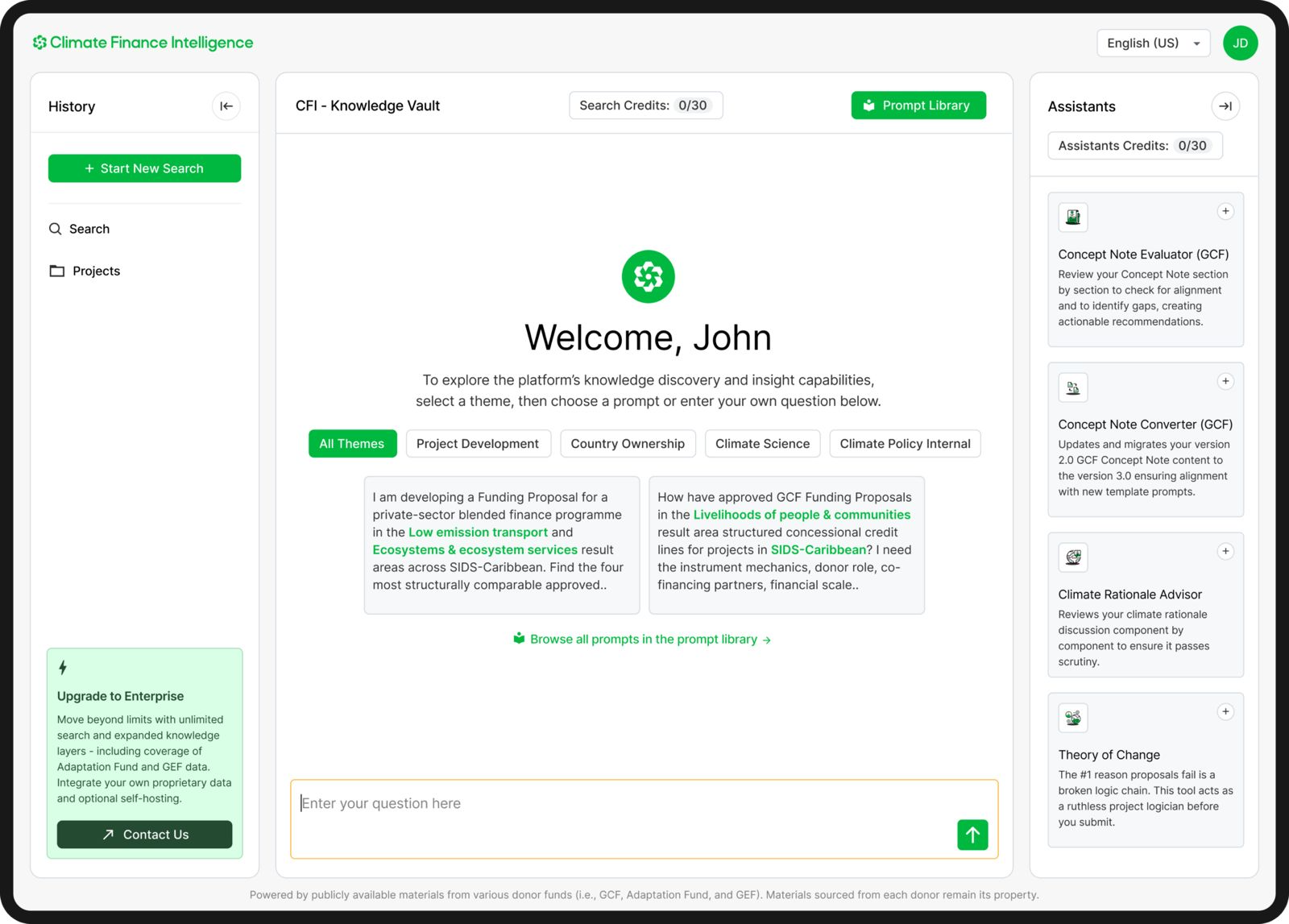
Built specifically for teams developing climate finance proposals, Climate Finance Intelligence turns static documents — both internal and external — into an instantly searchable knowledge base, delivering critical insights and donor alignment in seconds, not weeks.
Request a Demo
Both can hold a conversation about climate finance. Only one is grounded in the actual donor portfolios, national climate policy, and peer-reviewed science — with every claim traceable to its source.
| Capability | Generic AI Chatbot (e.g. Gemini) | Climate Finance Intelligence |
|---|---|---|
| Precedent proposals | ||
| Your own documents | ||
| Climate science evidence | ||
| Baseline vulnerability data | ||
| Research time | ||
| Traceability |
A generic chatbot reasons from general training data. Climate Finance Intelligence reasons from the actual donor portfolios, national climate policy documents, and peer-reviewed science — with every answer traceable to its source.
Climate Finance Intelligence is built on three powerful layers designed to rapidly deliver precise insights across a wide range of complex and analytical questions.
An Accredited Entity Analyst asks:
"We're preparing an ecosystem-based adaptation proposal for a strategic water-source area – what have we done before, what has the GCF approved, and what's the climate evidence?"
CFI Returns in Seconds:
Each tier includes a bundle of Assistant Credits and Search Credits. The Knowledge Vault (KV) is a database grounded in an indexed corpus of approved proposals that facilitates insight surfacing and more.
We've covered the most frequently asked questions below. If you have any additional questions, contact us at any time.
Climate Finance Intelligence (CFI) is a specialist AI platform built for climate finance practitioners — accredited entities, project preparation facilities, and advisory teams working with multilateral and bilateral Donor programs. It combines a purpose-built knowledge management system, AI-powered document evaluation tools, and institutional administration capabilities into a single platform designed to accelerate and strengthen the full project preparation cycle: from initial research through concept note development to funding proposal submission.
CFI is built for institutions that work professionally with climate finance — not individual researchers or general development practitioners. Its primary users are accredited entities managing active project pipelines, project preparation facilities supporting multiple applicants simultaneously, and advisory teams whose work depends on being able to produce high-quality, evidence-grounded submissions reliably and at scale. The platform is designed for team deployment, with enterprise-grade administration and cost controls.
CFI is a specialist enterprise platform, not a general-purpose chatbot. Key differences:
CFI's knowledge base includes material from the major multilateral and bilateral climate finance programs, with particular depth in the programs most active across Small Island Developing States and Least Developed Countries. Coverage continues to expand. For specific questions about whether your priority Donor programs are represented in the corpus at the depth your work requires, speak with your account team — they can give you a current, accurate picture rather than a generalized answer.
Your institution's data — documents you upload, queries you run, outputs you generate — is not shared with other organizations on the platform and is not used to train or update any underlying AI model. The platform operates on a zero-retention basis for query and session data. Institutional documents uploaded through the administration panel are accessible only to users within your organization. For clients with specific data residency, security certification, or contractual requirements, your account team can provide detailed technical and legal documentation.
No. The platform is designed for climate finance practitioners, not engineers. Day-to-day use — running queries, uploading documents for evaluation, accessing research outputs — requires no technical background. Administrative functions such as managing user access and setting usage budgets are handled through a web-based panel that does not require IT expertise to operate. Initial deployment, including any integration with your organization's identity management systems, may involve a brief setup step; your account team walks clients through this.
For most institutional clients, the platform is accessible within days of completing onboarding — there is no lengthy integration project required to start using the core research and evaluation tools. Your team can begin running queries against the shared knowledge base immediately. Uploading your own institutional documents and configuring team-level access and usage budgets adds a short additional setup step but does not gate access to the platform's core functionality.
Yes. The Master Administration Panel includes a Resource Center where administrators can upload and manage documents they want available to their team: internal templates, proprietary research, project-specific reference material, or any content that extends the platform's knowledge base with your institution's own assets. This content is accessible only to your organization's users and does not enter the shared corpus.
The platform is designed to disclose coverage gaps rather than fill them with inference. When a query touches a geography or topic where the underlying corpus lacks sufficient documentation, the system surfaces an explicit coverage-gap notice alongside its response — so your team knows the limits of available evidence rather than receiving a confident-sounding answer that isn't well-grounded. For thin-coverage regions or sectors, your account team can discuss the current state of the corpus and the roadmap for expanding it.
The corpus is actively maintained and expanded — it is not a static snapshot. New approved project documentation, updated national policy instruments, and new climate science literature are incorporated on an ongoing basis. Regional corpora are maintained separately to preserve geographic specificity, so updates to one region's documentation don't require re-indexing the full knowledge base. Clients are not responsible for managing corpus updates; that is handled at the platform level.
CFI operates on a token-based model, meaning cost tracks the volume of work the platform performs — queries run, documents processed, evaluations generated. Usage is tracked at the individual and organizational level through the Master Administration Panel, so administrators have real-time visibility into consumption before costs accumulate. Administrators can set per-user and per-team token budgets. Specific pricing depends on team size, usage volume, and the tools your institution requires. Contact your account team for a current rate card and to model expected cost against your workflows.
This is worth exploring with your account team and your Donor relationship. Many climate finance readiness and project preparation programs explicitly support capacity-building expenditures — including tools that improve the quality and efficiency of project preparation. Whether CFI qualifies under a specific program's eligible cost categories depends on the grant terms and how the expenditure is framed in your budget justification. We can support clients in preparing the documentation needed to make that case.
The platform is built for team deployment. The Master Administration Panel gives a designated administrator central control over user provisioning — adding and removing users, setting access levels, and assigning token budgets by individual or team. There is no separate account management system for each user; everything is managed from a single administrative interface. For larger institutions with multiple departments or client portfolios, usage can be tracked and budgeted at the team level rather than only at the organizational level.
The platform's interface and primary workflows operate in English. The underlying knowledge base includes national policy documents in local languages for some geographies, and the system can work with source documents in languages other than English — though retrieval and synthesis performance is strongest for English-language source material. If your work regularly involves documents in specific languages, speak with your account team about current capability and roadmap for those languages.
Institutional clients receive dedicated onboarding support, including setup of the administration panel, configuration of team access and budgets, and guidance on integrating CFI into your existing project preparation workflows. Ongoing support is available for technical issues, corpus coverage questions, and workflow optimization. The level of support included and available as an add-on varies by contract; your account team can walk through the options.
Request a demo and we'll walk you through the full CFI platform.